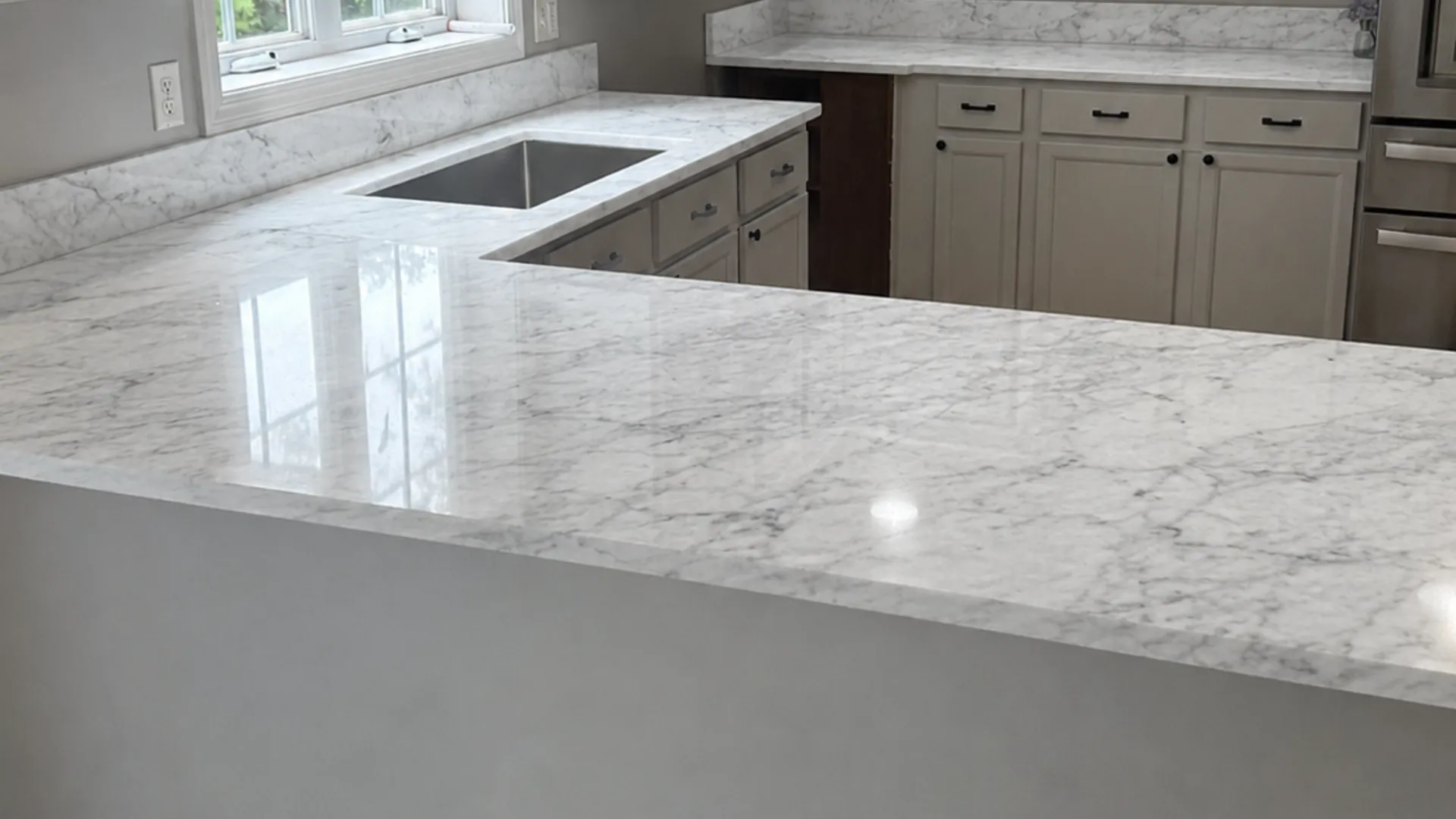
NH's Marble Restoration Specialists
Marble Countertop Repair in New Hampshire
Etch Removal · Chip Repair · Crack Stabilization · Re-Polishing & Honing
Marble requires a different level of skill to repair than granite or quartz. Our technicians understand how marble behaves — and how to restore it. Free written estimates. Most repairs completed in a single visit.
Why Marble Repair Is Different
Marble Demands a Specialist — Not a Generalist
Marble is calcium carbonate — one of the most beautiful and reactive natural stones used in countertops. It polishes to a glass-like finish no engineered material can replicate, but that same surface chemistry means it etches on contact with any acid, chips more easily than harder stones, and requires careful handling during repair.
Generic countertop repair technicians often treat marble like granite — using the same fillers, the same tools, and the same process. The results are repairs that stand out rather than blend in. Marble repair done correctly requires color-matching to the stone's specific background and veining, understanding the difference between polished and honed finish restoration, and knowing when a poultice is needed versus a re-polish.
At Precision Granite Works, marble is part of our core business. We fabricate and install marble countertops daily — which means our technicians understand the material intimately before they ever attempt to repair it.
Important: Don't use vinegar, lemon juice, or "natural" cleaners on marble
Many popular DIY cleaning solutions are highly acidic and will etch marble immediately. Use only pH-neutral stone cleaners. If you're unsure whether a product is safe, call us before applying it.
Get a Free Marble Repair Estimate
Describe your damage or send photos and we'll give you an honest, written assessment within one business day — no obligation, no sales pressure.
The 5 Types of Marble Damage
What We Repair — And What to Expect
Each type of marble damage requires a different approach. Here's an honest guide to each one — what causes it, how we repair it, and what the realistic outcome looks like.
Etch Mark Removal
Most common marble repairEtch marks are the most common complaint we hear from marble countertop owners — and they are marble-specific. They occur when an acidic substance (lemon juice, vinegar, wine, tomato, most common household cleaners) contacts the polished marble surface and chemically dissolves the top layer of calcium carbonate. The result is a dull, slightly rough haze or ring that looks like a water stain but won't wipe away.
On polished marble, etches appear as lighter, foggy rings or patches. On honed marble, they show as slightly darker, rough spots. The depth of the etch determines the repair approach: light etching is removed with professional diamond polishing compounds; deeper etching requires re-honing the surface back to a consistent scratch pattern, then re-polishing. The result is a fully restored, uniform finish.
Light to moderate etching on polished white and light marble. Surface etching on honed marble. Most wine, lemon, and cleaning product rings.
Extremely deep acid damage that has pitted the stone surface significantly — rare but possible with prolonged acid contact.
Chip Repair
Edge & surface chipsMarble is a softer stone than granite or quartzite, which means it chips more easily — particularly along edge profiles. A dropped pot, an impact from a heavy object, or even a hard bump against a sharp edge profile can leave a chip. The good news: marble chip repairs can be highly successful, especially on veined marble where the natural pattern variation helps camouflage the repair.
We use professional color-matched epoxy resins, tinted to match your specific marble's background color and veining. On highly veined Calacatta or Carrara marble, a skilled technician can hand-draw veining into the wet filler to make the repair nearly invisible. On very clean, uniform marble (like solid white Thassos), repairs are harder to make completely invisible but will still eliminate the sharp, damaged edge and make the chip non-noticeable from normal viewing distance.
Chips up to approximately 1" in size on surface or edge profiles. Most bullnose, eased, and ogee edge chips. Veined marble chips.
Very large chunks missing on unsupported overhangs. Chips on extremely plain, uniform white marble may show a slight repair line under close inspection.
Crack Stabilization & Repair
Surface & structural cracksCracks in marble countertops are more worrying-looking than they often need to be. Hairline surface cracks are common in marble slabs — some originate in the quarry, others develop from installation stress or point loads. Many homeowners discover hairline cracks in marble that have been there since installation, causing no structural issues whatsoever.
Surface cracks are repaired using penetrating epoxy that wicks into the crack by capillary action and bonds the stone together from within. Once cured, any residue is carefully removed and the surface polished. Structural cracks — those penetrating the full depth of the slab — require assessment of whether the slab has shifted. A crack that has held its plane can often be stabilized successfully. A crack near a sink cutout corner is the highest-risk location: we assess these carefully and give you an honest recommendation.
Hairline surface cracks. Structural cracks that have not shifted out of plane. Old cracks that have held stable.
Cracks through sink cutout corners where slab segments have shifted vertically out of plane typically require section replacement.
Stain Removal
Oils, wine, coffee & moreMarble is a porous natural stone — more porous than granite — and without adequate sealing it can absorb oils, wine, coffee, and other staining substances. Porous staining is different from etching: an etch mark is a physical surface change, while a stain is an absorbed substance. The correct treatment requires drawing the substance back out of the stone — not scrubbing it in further.
Professional stain removal uses a poultice — a thick drawing compound applied directly over the stain and sealed with plastic wrap to stay wet. As it dries over 24–48 hours, it pulls the absorbed substance out of the stone's pores. Multiple applications are usually needed for deep or old stains. After treatment, we apply fresh penetrating sealer to prevent recurrence. Oil-based stains (cooking oil, grease) and organic stains (coffee, wine, juice) respond very well to this process.
Oil stains, grease stains, wine, coffee, juice, rust stains, and most food-based organic staining on marble.
Stains from dyes or chemical products that have permanently altered the stone's mineral structure — very rare.
Re-Polishing & Honing Restoration
Full surface refinishingOver years of daily use, marble countertop surfaces can lose their original polish or hone — becoming increasingly dull, scratched, or uneven. This is especially noticeable on polished marble, where the high-gloss surface gradually takes on a worn, matte appearance. Full surface re-polishing restores the countertop to its original finish specification.
Surface refinishing uses a progression of diamond-tooling pads — from coarse to ultra-fine — to remove the worn surface layer and expose fresh stone underneath, then build the surface back up to the desired finish: high polish, honed, or leathered. This process can dramatically restore marble that looks tired, scratched, or etched across its entire surface. We can also use this process to intentionally switch a polished marble surface to a honed finish, which many homeowners prefer for its more forgiving, matte appearance.
Dull or scratched polished marble. Uneven finish from years of use. Widespread light etching across the full surface. Converting polished to honed finish.
Deep physical gouges from power tools or significant material removal — surface refinishing removes approximately 1–2mm of material.

Polished vs. Honed
Which Marble Finish Is Right for You?
The finish on your marble has a significant impact on how damage appears — and how easy it is to maintain. Here's the honest comparison.
Polished Marble
High-gloss, mirror-like surface that shows the full depth and color of the stone. Veining appears vivid and rich.
Honed Marble
Matte, satiny surface with no reflectivity. Colors appear slightly lighter and more subdued than polished.
Our Process
How We Repair Marble Countertops
Every repair follows the same methodical process — no shortcuts, no guesswork.
Damage Assessment
We examine the damage type, depth, and your specific marble variety. White Carrara behaves differently from Calacatta Gold, which behaves differently from a dark Marquina marble. We give you a clear, written estimate and honest expectation of results before any work begins.
Surface Cleaning & Prep
The marble surface is thoroughly cleaned with pH-neutral stone cleaner. Any residue, wax build-up, or old sealer is removed from the repair area. This step is critical for adhesion and color-matching accuracy.
Repair Application
Depending on damage type — etch, chip, crack, or stain — we apply the correct professional compound. Chip repairs use color-matched resin; we hand-tint and draw veining patterns to match your specific marble. Etch repairs begin with re-honing the affected area.
Shaping & Leveling
Cured chip repairs are carefully ground flush with diamond tooling, working in graduated steps from coarse to fine. The goal is a surface profile that perfectly matches the surrounding stone — no raised edges, no depressions.
Polishing & Finish Matching
The repaired area is brought up to match your marble's existing finish — high gloss polish, satin hone, or anywhere in between. Matching the exact gloss level to the surrounding surface is the most skilled step, and the difference between a repair that blends and one that doesn't.
Sealing
We finish every marble repair with a fresh application of professional-grade penetrating stone sealer over the repair area and a generous surrounding zone. This restores full stain and moisture protection and is the final step in a complete repair.
Repair vs. Replacement
Should You Repair or Replace Your Marble?
In most cases, repair is dramatically more cost-effective than replacement. Full marble countertop replacement involves new slab material, templating, fabrication, removal of the existing countertop, and installation — a substantial project compared to a targeted repair visit.
We'll always give you an honest recommendation. If repair is possible and will produce a result you'll be satisfied with, we'll repair it. If the damage is beyond what repair can address well, we'll tell you that too.
Repair is the right choice when:
Replacement may make more sense when:
Common Questions
Marble Countertop Repair FAQ
Everything NH homeowners ask us about marble repair — answered honestly.
What causes etch marks on marble countertops?
Etch marks are caused by acid reacting with the calcium carbonate in marble. Marble is primarily composed of calcite — a mineral that reacts immediately with any acid it contacts. Common culprits in kitchens are lemon juice, lime, vinegar, wine, tomato sauce, citrus-based cleaners, and many all-purpose household cleaners. The acid doesn't scratch the marble — it chemically dissolves the top layer of polished surface, leaving a dull, rough patch. On polished marble this looks like a foggy ring; on honed marble it appears as a slightly darker rough area. Prevention means wiping acidic spills immediately and using only pH-neutral cleaners on marble.
Can etch marks on marble be repaired?
Yes — etch mark removal is one of the most successful marble repairs we perform. Light to moderate etching on polished marble responds very well to professional re-polishing compounds that resurface the affected area. Deeper etching requires re-honing the surface back to a consistent scratch pattern and then re-polishing. In most cases, a professionally treated etch mark is undetectable after repair. The key is using the correct diamond tooling and polishing progression — household marble polishing products rarely produce professional results.
Is honed marble easier to maintain than polished marble?
Yes, significantly. Etch marks still occur on honed marble when acid contacts the surface, but they are far less visible — the matte finish masks the contrast between etched and unetched areas. Scratches are also less visible on a honed surface. The trade-off is that honed marble can absorb stains slightly faster than polished marble since the surface isn't as tightly sealed. We recommend honed marble for kitchens used daily and polished marble for bathrooms, fireplace surrounds, or kitchens where the countertop is more decorative than functional.
How visible will a chip repair be on my marble?
This depends heavily on the specific marble and the chip location. On Calacatta, Carrara, or any marble with significant veining, chip repairs can be nearly invisible — we tint the epoxy to match the background and hand-draw veining patterns into the repair. On plain, very uniform white marble (like Thassos or some solid bianco varieties), a professional will be able to locate the repair on close inspection, but it won't be noticeable from normal standing distance. We'll give you an honest, specific expectation for your marble before we start.
What's the difference between a marble stain and an etch mark?
A stain is an absorbed substance inside the marble's pores — oil, wine, coffee. It typically appears as a darkened area with soft edges and does not feel different when you run your finger over it. An etch mark is physical surface damage — the top layer of polished marble has been dissolved by acid. It feels slightly rough or dull compared to surrounding stone. You can sometimes have both at once (a lemon left on marble can both etch the surface and leave an oil stain). Treatment is different for each: stains require a drawing poultice; etches require re-polishing.
Can a crack in my marble countertop near the sink be repaired?
It depends on the crack. Sink cutout corners are stress concentration points, and cracks there are the most common structural marble crack we assess. If the slab has not shifted — both sides of the crack are still in the same vertical plane — it can almost always be stabilized with penetrating structural epoxy and will hold well long-term. If the slab has shifted and one side is higher than the other, stabilization alone won't produce a flush surface, and replacement of that countertop section is usually the right recommendation. We assess every crack honestly and won't recommend repair if replacement is truly the better option.
How do I get a stain out of my marble countertop?
Do not scrub with abrasive materials — this will scratch the surface. Do not use acidic cleaners (vinegar, lemon juice-based products) — these will etch. The correct DIY approach for a fresh stain is to cover it with a poultice made from baking soda and water (for oil stains) or hydrogen peroxide and flour (for organic stains), cover with plastic wrap, and let it draw the stain out for 24–48 hours. For old or stubborn stains, professional treatment is significantly more effective. We use commercial-grade drawing compounds that far outperform DIY materials.
Should I repair or replace my marble countertop?
Repair is the right answer in most cases. Even significant damage — multiple etch areas, a chip, a crack — is usually repairable at a fraction of replacement cost. Replacement involves new material, templating, fabrication, and installation, plus the disruption of a full countertop swap. We recommend replacement only when: (1) the damage is structural and widespread across the entire slab, (2) a crack has caused the slab to shift out of plane in a way that cannot be safely stabilized, or (3) you want to change materials entirely. If you're on the fence, send us photos and we'll give you an honest assessment.
How often should I seal my marble countertop?
Marble should be sealed every 6–12 months in kitchens, or whenever the surface begins to absorb water within a few seconds of contact (pour a tablespoon of water on the surface — if it darkens immediately rather than beading, it's time to reseal). We use professional-grade penetrating sealers that outperform consumer products significantly. After any repair, we always apply a fresh sealer coat to the repair area as part of the job.
Explore More
Other Stone Options
What Our Marble Repair Customers Say
"I was devastated when I saw the etch rings on my Calacatta marble from a lemon — it looked ruined. Precision Granite Works came out, assessed it, and restored it to near perfect. I honestly can't find where the damage was. Truly impressive work."
"Had a chip on the corner of my marble island — about the size of a quarter. I thought it would be obvious forever. They repaired it in about two hours and you genuinely cannot find it unless you know exactly where to look."
"Multiple etch marks on my honed white marble from years of use. Precision Granite Works re-honed the whole surface and it looks brand new. Worth every penny to avoid replacing a slab I love."
"We had a crack near the sink cutout that scared us. They assessed it honestly, told us it was stable and repairable, and the repair has held perfectly for months. Honest and skilled — exactly what you want."
Ready to restore your marble countertop?