Rounded and Curved Kitchen Islands: What to Know Before Choosing a Curved Countertop
Curved islands are one of 2026's most visible kitchen trends, but the shape has to work as well as it photographs. This guide explains radius choices, cabinet coordination, seating, stone movement, support, and the fabrication decisions homeowners should make early.
By Precision Granite Works Team · Precision Granite Works, Epsom NH
For a long time, most kitchen islands were variations of the same shape: a rectangle with four square corners.
That is changing. Houzz's 2026 U.S. Emerging Summer Trends Report found searches for 'rounded kitchen island' up 123% and searches for 'curved peninsulas and islands' up 61%. Homeowners are looking for softer forms in rooms that have traditionally been dominated by straight cabinet lines.
A curved island can be beautiful. It can also improve circulation, make seating feel more conversational, and remove a hard corner from a busy walkway. But stone does not bend, and a rounded inspiration photo may hide complicated cabinetry, support, templating, pattern, and cost decisions.
The right question is not simply whether curved islands are in style. It is which kind of curve works in your room and whether the countertop, cabinets, and structure have been designed as one system.
What Counts as a Curved Kitchen Island?
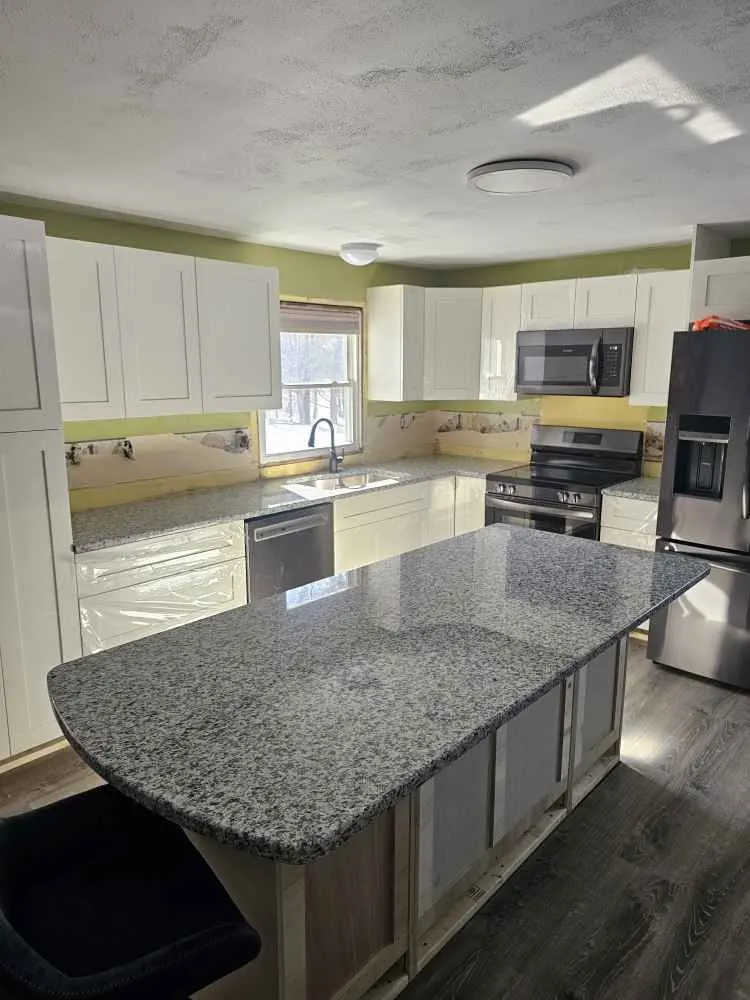
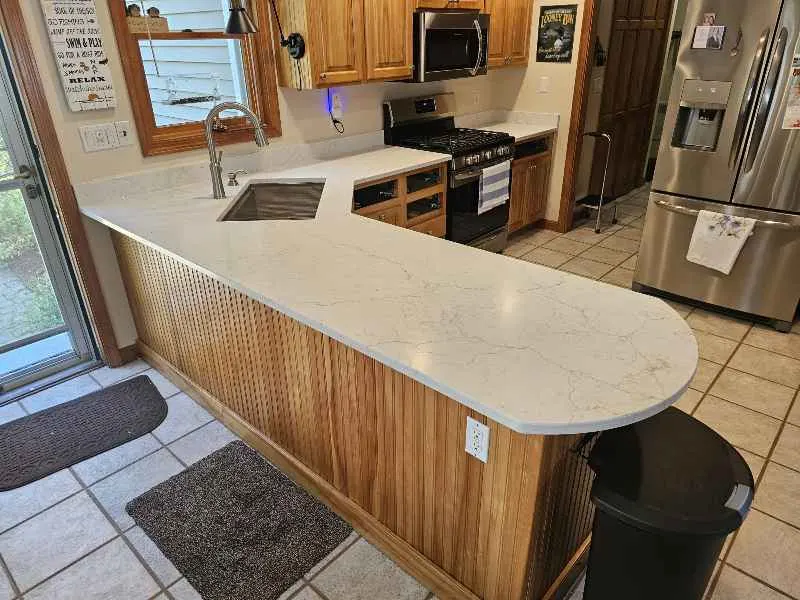
The phrase covers several different designs. A standard rectangular island may have generously rounded countertop corners while the cabinet stays square. Another island may have one semicircular seating end. A third may use curved cabinet fronts and an oval or capsule-shaped countertop.
There are also curved peninsulas, kidney-shaped islands, bow-front overhangs, and rounded waterfall ends. Each requires a different level of custom work.
A small corner radius is mostly a countertop detail. A fully curved island changes cabinet construction, storage, toe kicks, seating geometry, supports, floor clearances, and slab layout.
Define the shape before comparing prices. Saying 'rounded island' is not enough for a cabinetmaker or fabricator to know what is being requested. A plan should show the radius, overall dimensions, cabinet footprint, overhang, and finished edge.
Why Curves Feel Good in a Kitchen
Kitchens contain many hard lines: cabinet boxes, appliance doors, tile grids, plank floors, and rectangular windows. One curved element can make the room feel less rigid without changing every surface.
A rounded end also changes how people move around the island. Instead of approaching a sharp corner, traffic can follow the shape. This is useful where an island sits near a doorway, refrigerator path, dining area, or family-room opening.
Curves can make seating feel more social. People arranged along an arc can see one another more easily than people sitting in a straight row.
Those benefits depend on proportion. A curve that pushes too far into the aisle makes circulation worse. A tiny radius on an oversized island may look timid rather than intentional. The room plan must lead the shape.
Rounded Corners vs. a Fully Curved Island
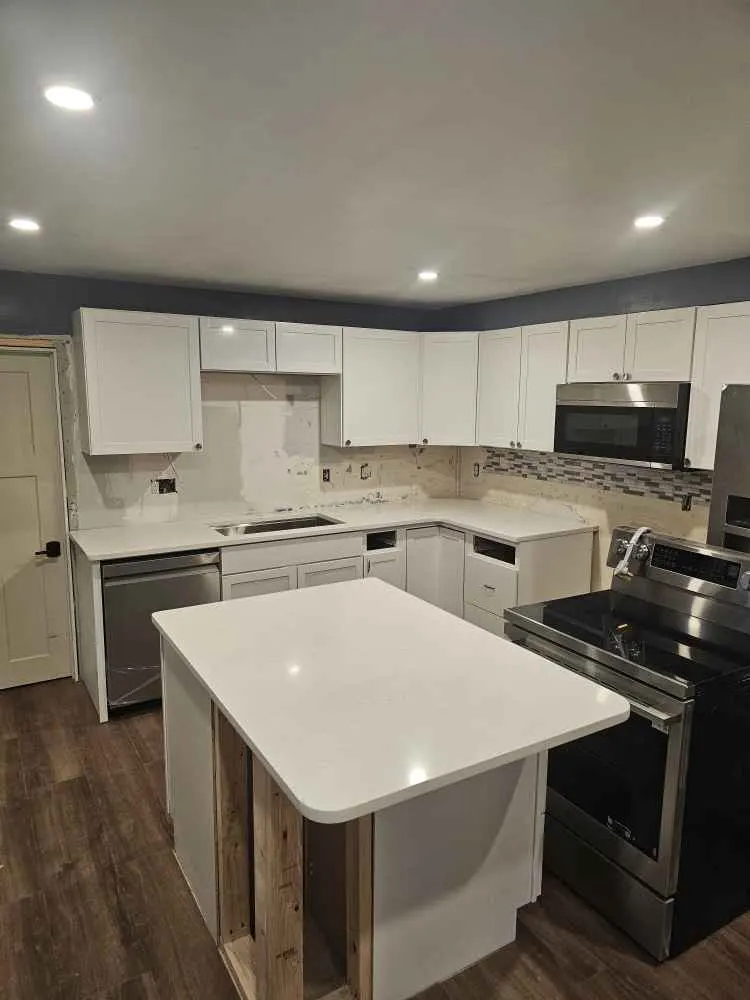
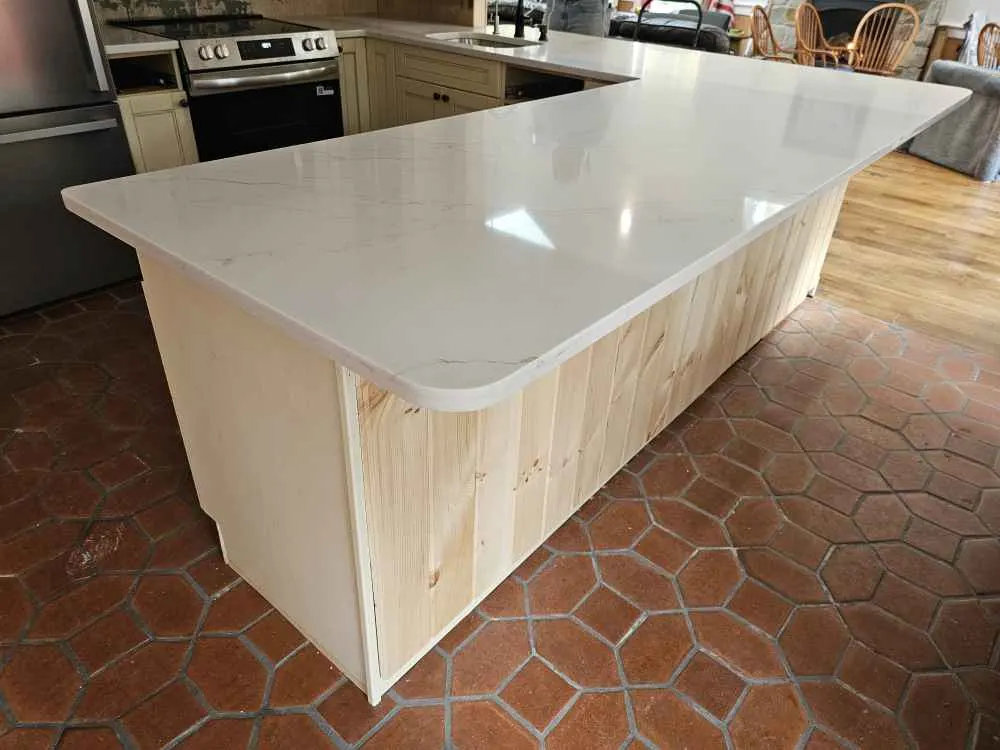
Rounded corners are the simplest way to introduce softness. The cabinet can remain rectangular while the countertop corner receives a chosen radius. This can reduce the severity of a stone corner in a high-traffic area and works in many kitchen styles.
A curved seating end has more visual impact. It may create room for stools around the arc, but the cabinet and support plan must account for the wider cantilever.
A fully curved island is a custom architectural feature. Cabinet doors, drawers, panels, toe kicks, and internal storage may all need special construction. Stone layout becomes more complicated because the perimeter is no longer made of straight cuts.
Choose the least complex curve that solves the design problem. If the goal is safer circulation, rounded corners may be enough. If the goal is communal seating or a sculptural centerpiece, a deeper curve may be worth the additional planning.
Start With Circulation, Not the Countertop Shape
Before drawing the curve, map the working aisles. Open the refrigerator, dishwasher, oven, and nearby doors on the plan. Mark where people enter the kitchen and how they travel between the sink, cooking area, pantry, and seating.
A curve should give movement more room, not steal it. The widest part of the arc controls the clearance, even if the island feels narrow at its ends.
Mock up the shape with painter's tape or cardboard at full scale. Walk around it while another person opens appliances. Pull out stools. Carry a laundry basket through the aisle. A floor plan can make a shape look comfortable when the real room does not.
This test is especially important in older New Hampshire homes where walls, doorways, and cabinet runs may not be perfectly square.
How Curves Affect Island Seating
Curved seating can feel more like a table and less like a counter. It also changes how much edge length each stool receives and how knees share the space below.
Do not count stools only by dividing the curved edge into equal pieces. Stool width, swivel movement, supports, cabinet doors, electrical outlets, and the depth of knee space all matter.
A broad arc may allow people to face one another, but a tight curve can angle knees into the same central area. The cabinet base may need to be pulled back or shaped to create usable legroom.
Choose stools before finalizing the template if possible. Their seat height, width, arms, and footrests affect the overhang. Precision Granite Works notes that counter-height seating commonly starts around a 12-inch overhang, with 15 inches often feeling more comfortable, but the final dimension and support must be specified for the actual project.
Do Rounded Corners Make a Kitchen Safer?
A rounded corner removes the sharpest point of a hard surface. That can be helpful in a busy path and in homes with children, older adults, or anyone who tends to catch a hip on the island.
It does not make stone soft. A broad radius can reduce the severity of a collision, but the countertop is still a rigid, heavy surface.
The edge profile matters too. A lightly eased edge removes the knife-sharp feeling of a square top. Manufacturer guidance for engineered surfaces often recommends a small eased or rounded profile to reduce chipping risk at exposed edges.
Think of a curve as one part of a safer layout. Adequate aisles, stable seating, good lighting, protected outlets, and properly supported overhangs matter just as much.
Which Countertop Materials Work for Curved Shapes?
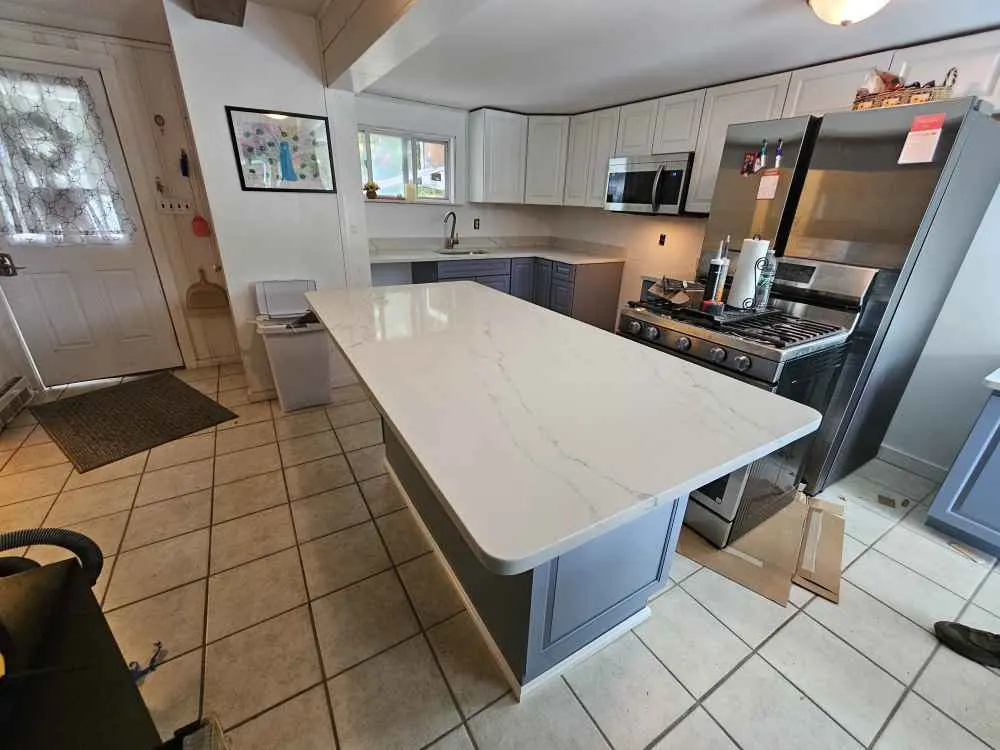
Granite, quartz, quartzite, marble, and soapstone can all be fabricated with radiused outside edges, subject to the properties of the specific slab and the capabilities of the shop.
Natural stone introduces variation. A curve may cross crystals, veins, fissures, or repaired areas differently than a straight edge. The fabricator needs to evaluate the exact slab and decide where the shape can be cut safely and attractively.
Engineered quartz offers more predictable color and pattern, but manufacturers set fabrication rules for corners, edge profiles, cutouts, and support. Those rules should be followed.
Tighter curves and complex built-up edges require more labor than a simple radius. Do not assume every inspiration detail is available in every material. Ask what the shop can fabricate before final cabinet drawings are released.
The Cabinet and Countertop Curves Must Agree
One of the most common design problems is a rounded countertop sitting on a cabinet base that was not designed for it. A small overhang can hide a square cabinet corner. A deep curve cannot.
If the countertop projects far beyond a straight cabinet, the underside may look empty and require visible or hidden support. If the cabinets are curved, the template must capture that geometry accurately.
End panels, doors, drawers, appliance clearances, and toe kicks all need to follow the design. Curved cabinetry can reduce usable storage or require custom interior fittings.
Coordinate the cabinetmaker and fabricator early. The countertop should not be asked to correct a cabinet shape after installation. Once the cabinets are set, the digital template should confirm the real dimensions rather than relying only on drawings.
How Veining and Pattern Behave on a Curve
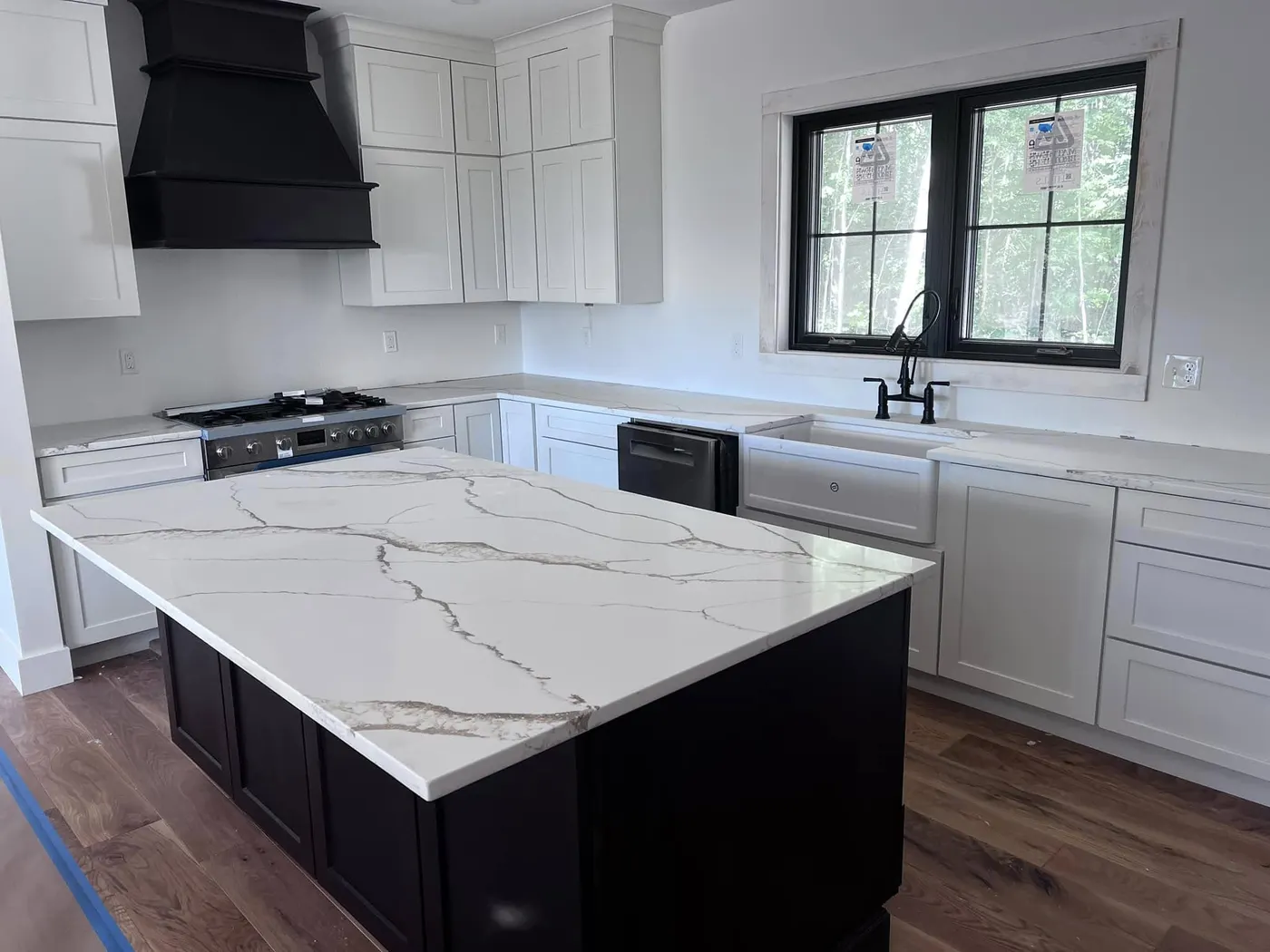
A curved outline changes how the eye reads stone movement. Long linear veins may be clipped at the arc. Broad, cloudlike movement may feel more natural around the shape.
The direction of the slab should be chosen with the main view in mind. A vein can lead toward the curve, follow the island length, or cross the seating end. Each creates a different emphasis.
For natural stone, review a digital slab layout when available. Make sure the most important movement will not be removed by the curved cut, sink, cooktop, or outlet opening. For more, see our guide to bold veining vs. subtle movement.
For engineered patterns, ask how repeats and direction will appear. A curved edge exposes a long section of the pattern, and a built-up or waterfall treatment may require additional matching.
Edge Profiles and Curved Countertops
Simple edges usually show a curve most clearly. An eased or softly rounded profile follows the radius without adding visual noise.
Decorative profiles can be fabricated on some curved shapes, but the detail may read differently around a tight arc. It can also require more hand finishing and increase cost.
A thick mitered look is more complicated on a curve because straight stone pieces cannot bend around the radius. The method depends on the material, radius, and desired appearance. A faceted or built-up solution may be necessary, and seam visibility should be discussed honestly.
Do not approve an edge from a straight sample alone. Ask how it will transition around the curve and at any point where the radius meets a straight run. See more countertop edge profiles.
Curved Overhangs Need a Support Plan
A curved seating edge may create a deeper overhang at the center of the arc than at the sides. That deepest point often controls the structural design.
Material, thickness, cabinet support, cutouts, seams, and expected use all affect how the top should be reinforced. Hidden steel, brackets, corbels, posts, or a shaped substrate may be considered depending on the project.
Support should be designed before cabinets are built. Adding brackets after templating can interfere with drawers, panels, outlets, or legroom.
Never assume that a smooth curve is self-supporting because it has no sharp corner. Stone is strong in compression but can crack under bending or concentrated loads. Follow the fabricator's written requirements for the exact layout.
What Makes a Curved Island Cost More?
The curve itself adds machining and finishing time. A custom cabinet base, specialized templates, shaped supports, premium edge work, and more complex slab layout can add further cost.
Material yield may be less efficient because a curved piece occupies a large rectangle within the slab even though part of that rectangle is cut away. The offcut may not fit another project piece.
A curved waterfall, thick mitered edge, or full oval shape is substantially more involved than two rounded outside corners. Installation access also matters; a large custom piece must travel through the home safely.
Request an itemized quote after the radius and cabinet plan are defined. Pricing a generic rectangle and adding 'rounded later' is not a reliable budget.
When a Curved Island May Not Be the Best Choice
Avoid forcing a curve into a narrow kitchen where the widest point reduces the working aisle. A rectangle may provide more useful prep space and storage.
A curve may also fight a highly formal room built around strict symmetry and detailed traditional cabinetry. Rounded corners can still work, but a sculptural oval may feel unrelated.
If the budget is already tight, prioritize cabinet quality, functional clearances, support, and the countertop material before adding complex geometry.
Finally, consider longevity. Choose a curve because it improves the room, not only because it is trending. A practical radius tied to circulation and seating is more likely to age well than a shape that exists only for a photograph.
Questions to Resolve Before Templating
- What problem is the curve solving: circulation, safety, seating, or visual softness?
- What is the exact radius and where does it begin and end?
- Does the cabinet base follow the curve or stay rectangular?
- How many stools should fit, and what knee space do they require?
- What is the deepest overhang and how will it be supported?
- How will the edge profile turn the radius?
- Which direction should the stone movement run?
- Can the finished piece be carried through the home and installed safely?
Fabricator Recommendation: Approve the Full-Size Shape
A curved island should be approved as geometry, not as a mood-board image.
Tape it on the floor. Coordinate the cabinet footprint and support. Select the material with the radius in mind. Review the digital template and slab layout. Confirm edge transitions and stool clearances.
Small changes in radius can affect walking space, yield, pattern, and cost. Make those changes before the stone is cut.
When the curve grows naturally from the room, it can feel welcoming for years. When it is added late, the countertop is forced to solve decisions that belong to the entire island.
Plan a Curved Countertop With Precision Granite Works
Rounded kitchen islands are more than a visual trend. They can improve movement, soften exposed corners, and create a better gathering space when the design is properly coordinated.
Precision Granite Works can help review granite, quartz, quartzite, marble, and soapstone options, capture the installed cabinets with digital templating, and plan the radius, edge, pattern, cutouts, and support.
Bring your cabinet drawings, room dimensions, stool information, and inspiration photos to the showroom at 1022 Dover Road in Epsom, NH. The earlier the fabricator sees the idea, the easier it is to turn the curve into a practical countertop. Explore our kitchen island countertops or request a quote.
Frequently Asked Questions
Are rounded kitchen islands practical?+
Do curved countertops waste space?+
Can natural stone be used for a curved island?+
Does a curve cost more?+
What edge works on a radius?+
How are curved overhangs supported?+
How many stools fit at a curved island?+
When should the curve be finalized?+
Ready to Start Your Project?
Contact Precision Granite Works for a free consultation and quote at our Epsom, NH showroom.
About the Author
Written by the team at Precision Granite Works — New Hampshire's family-owned countertop fabricators. Jillian and Shawn Woodward and their team serve homeowners and builders across all of NH from our Epsom showroom.