Soapstone Countertops: Pros, Cons, Care, and How They Compare
Soapstone is a dense, nonporous natural stone with a smooth matte feel and a patina that becomes more personal with use. This guide explains what it handles well, where it marks, how to care for it, and who is likely to enjoy living with it.
By Precision Granite Works Team · Precision Granite Works, Epsom NH
Soapstone countertops are nonporous, do not require sealing, resist common household acids, and tolerate heat well. Their main tradeoff is softness: edges can dent and surfaces can scratch, though many marks can be blended and become part of the patina. Choose soapstone if you value tactile natural character over a permanently uniform finish.
What Is Soapstone?
Soapstone is a natural metamorphic stone composed largely of talc, with other minerals contributing strength, color, and veining. Architectural soapstone used for countertops is harder than the soft carving grades many people remember from science class, but it remains softer than granite and quartzite. That softness gives the surface its distinctive, almost dry-smooth feel.
Most countertop soapstone is gray to charcoal, sometimes with green, blue, or black undertones and pale mineral veins. It is generally finished honed rather than glossy. The restrained palette can feel historic, modern, industrial, or warm and traditional depending on the cabinetry, metal finishes, and whether the surface is allowed to lighten or is treated to deepen its color.
Why Soapstone Deserves a Closer Look
Soapstone is not the most commonly selected kitchen surface. The 2026 U.S. Houzz Kitchen Trends Study reported it at four percent among upgraded countertop materials. That smaller share is useful context: choosing soapstone is usually a deliberate preference for its performance and character, not a default decision driven by widespread availability.
It appeals to homeowners who want real stone without a polished, reflective appearance. It also has a long history in laboratories, sinks, hearths, and work surfaces because of its density and response to heat and chemicals. Residential slabs bring those qualities into a surface that grows more personal over time.
Pro: Soapstone Is Nonporous
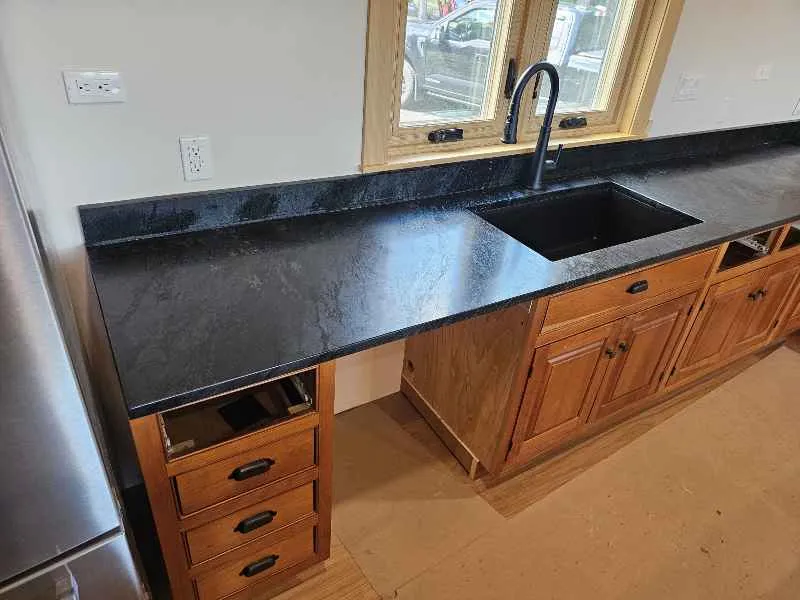
Soapstone has extremely low absorption and does not need a penetrating sealer. Common kitchen liquids remain at the surface long enough to be wiped away rather than readily soaking in. This makes it appealing around sinks, coffee stations, bars, and hardworking preparation areas.
Nonporous does not mean maintenance-free or impossible to mark. Grease can temporarily darken an untreated area, soap residue can build up, and caulk or seams still need normal care. The advantage is that sealing is not part of the routine and many surface marks can be cleaned or blended.
Pro: It Handles Heat Well
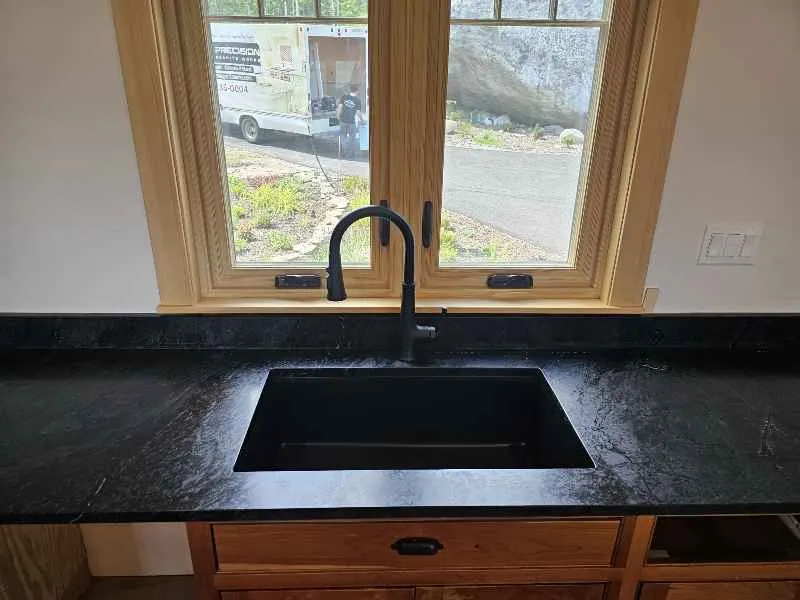
Soapstone tolerates heat and has been used around fireplaces and laboratory burners for generations. A brief encounter with a warm pan is less threatening to the stone than it would be to many resin-based surfaces. That performance is one reason cooks are drawn to it.
Good kitchen habits still matter. Trivets protect finishes, seams, adhesives, surrounding cabinetry, and cookware, and they avoid thermal shock from extreme or uneven temperatures. Product care guidance and the fabricator’s instructions should take priority over demonstrations on social media.
Pro: Household Acids Do Not Etch It Like Marble
Lemon, vinegar, tomato, and wine are concerns on calcite-rich marble and limestone because acids can chemically dull the surface. Soapstone is not calcite-based and does not react in the same way, so it avoids the classic acid-etch issue.
Spills should still be wiped promptly for cleanliness and to prevent residues, oils, or pigments from lingering at seams and adjacent materials. The practical distinction is that soapstone owners do not have to treat every squeeze of citrus as an emergency.
Pro: The Color Can Be Renewed
Untreated soapstone starts lighter and gradually darkens where hands, water, and oils touch it. Mineral oil or a soapstone-specific wax can accelerate and even out that darkening. The treatment does not seal the stone; it changes the appearance and can help blend light scratches or uneven patina.
Some homeowners periodically reapply a treatment for a deep charcoal look. Others stop after the first few applications or never oil the surface at all. Both approaches can be valid. Ask to see the selected slab dry and darkened so you understand the range before choosing.
Con: Soapstone Scratches
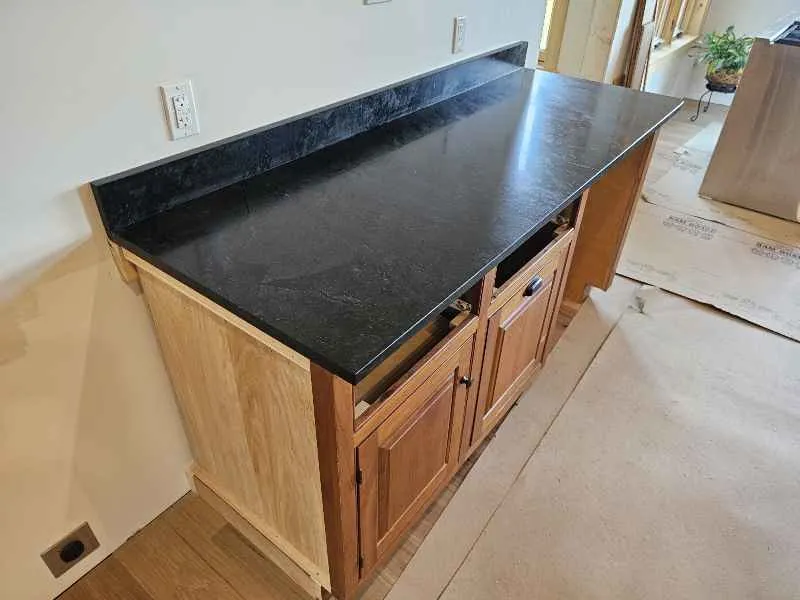
Soapstone’s softness means knives, ceramic bases, metal objects, grit under small appliances, and dragged cookware can leave scratches. This is not a rare defect; it is a normal ownership characteristic. Fine marks may become part of an even patina, while deeper scratches can remain visible.
Many scratches can be blended with fine abrasive work and then retreated, but repair technique should match the finish and depth. Practice on a sample and follow the fabricator’s guidance. Cutting boards and felt pads reduce avoidable marks without asking the kitchen to become a museum.
Con: Edges Can Dent or Chip
The same softness that makes scratches repairable can allow a hard impact to bruise an edge or corner. A heavy cast-iron pan, dropped bottle, or repeated contact near a dishwasher may leave a small dent. Crisp, projecting corners are more vulnerable than softened profiles.
Choose an edge that suits the stone and household. An eased, rounded, or other restrained profile can feel natural and reduce sharp exposure. Complex decorative edges may not be the best use of a material whose beauty comes from simplicity and touch.
Patina Is the Central Design Decision
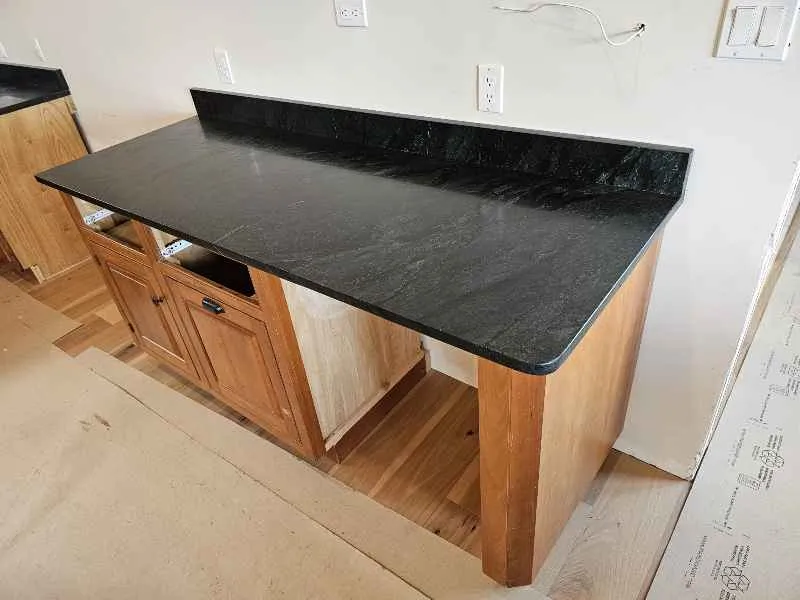
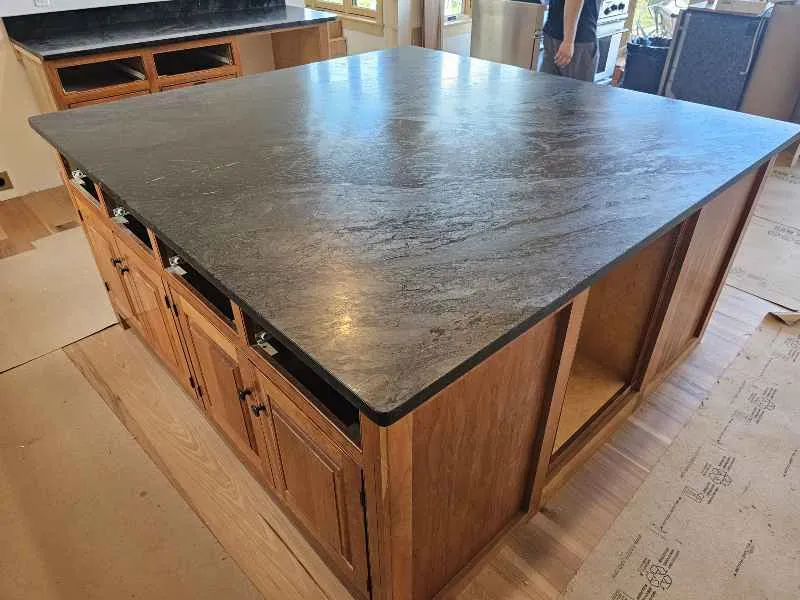
Patina describes the accumulated visual evidence of use: darkened areas, fine scratches, softened details, and subtle variation. In soapstone, patina is not merely a maintenance problem to solve. It is part of what separates the material from a surface designed to remain visually uniform.
Look at an installed soapstone kitchen that has been used for several years, not only a fresh showroom sample. If the matured surface feels warm and authentic, soapstone may be a strong fit. If every line and color shift would bother you, the daily relationship may be frustrating despite the material’s other advantages.
Should You Oil Soapstone?
Oiling is optional. It does not make the stone sanitary or stainproof; the stone is already nonporous. Mineral oil temporarily deepens the color and helps the surface develop a more even dark appearance. Soapstone waxes may last differently and should be used according to their instructions.
Early applications can fade as the oil evaporates or is washed away, so the color may appear uneven until the process stabilizes. Apply a thin coat, allow it to sit as directed, and remove excess thoroughly. Food-grade products intended for the purpose are preferable to improvised treatments.
Simple Daily Care
For routine cleaning, use a soft cloth or sponge with mild dish soap and water. Remove crumbs and grit before sliding appliances or trays. Avoid leaving harsh chemicals at seams, caulk, sinks, or adjacent finishes, even though the stone itself is chemically resistant.
When a mark appears, identify it before sanding. Oil, residue, a scratch, and a natural mineral line require different responses. Keep a sample from the project if possible; it is valuable for testing cleaners, oil, wax, and abrasion without experimenting in the center of the island. For more ownership guidance, review our countertop care and maintenance guide.
Colors, Veins, and Slab Selection
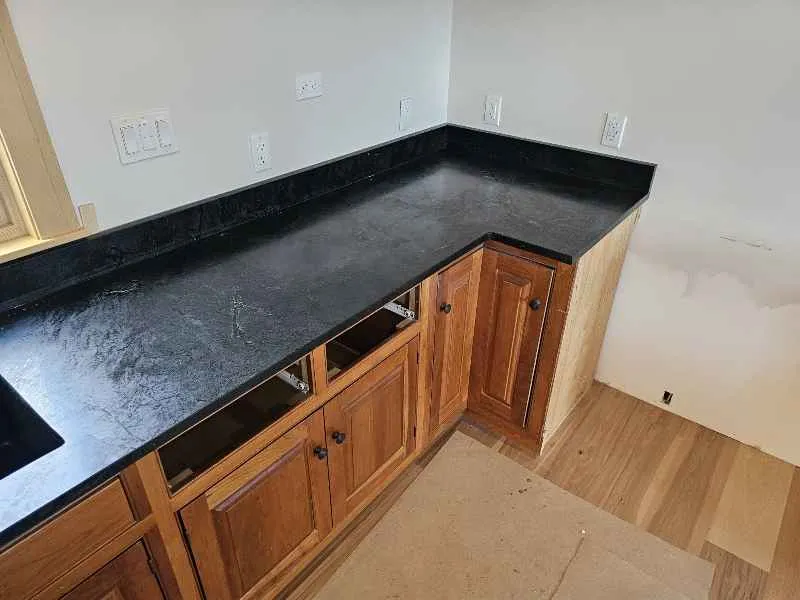
Soapstone is often described simply as black, but most slabs begin in a range of grays. Some have quiet, nearly uniform fields; others contain bold white or greenish veins. Darkening treatment can reveal contrast that is subtle when the slab is dry.
View full slabs and note fissures, veins, surface variation, and the direction of movement. Decide which features belong on the island or focal run and where seams should fall. Because selection can be limited compared with common quartz colors, reserve coordinating slabs before final layout when the project requires more than one.
Soapstone Versus Granite
Granite countertops are generally harder and more scratch resistant, offer a much broader color range, and can be polished or honed. Many granites benefit from periodic sealing, depending on absorption and use. Soapstone is nonporous and typically quieter, darker, softer, and matte.
Choose granite when you want greater hardness, bright or varied colors, or a reflective finish. Choose soapstone when tactile warmth, acid resistance, no sealing, and a developing patina matter more than keeping the surface free of fine marks.
Soapstone Versus Quartz
Engineered quartz countertops are nonporous and offer controlled color and pattern with strong scratch resistance in normal use. Their resin content makes heat protection important, and a repeated printed design does not have the one-of-a-kind mineral character of natural stone.
Soapstone handles heat and household acids well and can be sanded or darkened to refresh its appearance, but it scratches more readily. Quartz is usually the better fit for a homeowner who wants predictable visual consistency; soapstone suits someone who wants natural variation and accepts evolution.
Soapstone Versus Quartzite
Quartzite countertops are made from a very hard natural stone, often selected for luminous movement and marble-like veining with greater scratch resistance. Many quartzites require sealing, and materials sold under that label should be properly identified because care characteristics can differ.
Soapstone has lower visual contrast in many slabs, no sealing requirement, and much greater softness. The choice is not about which stone is universally superior. It is whether the room needs quartzite’s hardness and drama or soapstone’s matte restraint and forgiving response to acids.
Soapstone Versus Marble
Both materials can develop patina and appeal to homeowners who value natural surfaces over permanent perfection. Marble is harder than soapstone but can etch from common acids and may stain if not properly protected. Soapstone avoids acid etching and absorption but scratches and dents more easily.
Marble usually offers a lighter palette and a different architectural tradition; soapstone brings deeper color and a utilitarian, grounded quality. Seeing aged examples of both is the most honest comparison. Their beauty is tied to how they change.
Where Soapstone Works Especially Well
Soapstone can be excellent on a kitchen countertop, island, bar, laundry counter, vanity, pantry, fireplace surround, or hearth when the assembly is designed correctly. Around sinks, its low absorption is valuable. Near cooking, its heat and acid resistance are attractive.
It pairs naturally with white oak, walnut, painted cream, deep green, navy, and simple Shaker cabinetry. Brass can warm it; stainless steel can emphasize its workshop history; black hardware creates a quieter monochrome composition. Samples should be viewed with the slab both dry and darkened.
When Soapstone May Not Be the Best Choice
If you expect the countertop to look untouched after years of family use, soapstone may create unnecessary stress. It is also a poor place to insist on razor-sharp projecting corners or highly ornate edges. Households that routinely drag heavy appliances should be willing to change those habits or accept marks.
A very bright kitchen may also need careful material balancing because dark counters can absorb light. That does not rule them out; it means cabinet color, backsplash, lighting, and the amount of soapstone should be considered together. Using it on one focal area can be a useful compromise.
What Affects Soapstone Cost?
Installed price depends on slab grade and availability, thickness, project size, slab yield, seams, edge work, sink and cooktop cutouts, drainboards, backsplash, delivery, site access, removal, and installation. A small project is not priced only by multiplying a material rate by square feet.
Soapstone can require experienced handling and fabrication because of its softness. Ask for a complete project estimate and compare it with other materials at the same scope. Also ask how leftover material, repairs, oiling, and future additions are handled.
Common Soapstone Myths
Soapstone is not the powder-soft material used for every carving, and architectural slabs can serve demanding kitchens. It is not completely black when untreated, and oil is not a sealer. It is not maintenance-free, but its care is different from periodic penetrating sealer schedules.
It is also misleading to promise that every scratch disappears. Fine marks may blend; deeper damage can remain or require professional attention. Honest expectations are more valuable than superlatives because satisfaction depends on appreciating the surface’s real behavior.
Questions to Ask Before Selecting a Slab
- Can I see this exact slab dry and darkened?
- How hard is this soapstone relative to other available slabs?
- Which veins or natural features should be highlighted or avoided?
- Where will seams, sinks, cooktops, and finished edges be located?
- Which edge profiles are appropriate for this material and household?
- What daily cleaner and optional oil or wax do you recommend?
- Can I keep a sample for testing and future care?
- What should I expect the installed surface to look like after several years?
The Bottom Line
Soapstone offers a rare combination: natural stone, near-zero absorption, no sealing, excellent heat performance, resistance to common kitchen acids, and a surface that can be renewed. Its cost of admission is softness and visible patina.
The right buyer does not merely tolerate that evolution; they find it meaningful. Touch a full slab, compare dry and darkened color, scratch a sample, and look at aged installations. Those simple tests reveal more than a list of specifications.
Explore Soapstone With Precision Granite Works
Precision Granite Works helps homeowners across Epsom, Concord, Manchester, the Lakes Region, the Seacoast, Southern New Hampshire, and nearby Maine and Vermont compare soapstone with granite, quartz, quartzite, and marble; review full slabs; plan seams and pattern placement; and coordinate digital templating, fabrication, and installation.
Visit our showroom at 1022 Dover Road in Epsom, NH with cabinet, flooring, backsplash, and hardware samples. Choosing soapstone is partly a performance decision and partly a relationship with a changing natural surface. See and touch the material in context, then request a quote when you are ready to discuss your project.
Frequently Asked Questions
Does soapstone need to be sealed?+
Do soapstone countertops stain?+
Does soapstone scratch easily?+
Can hot pans go on soapstone?+
Should soapstone be oiled?+
What colors does soapstone come in?+
Is soapstone more expensive than granite or quartz?+
Is soapstone good for a busy kitchen?+
Ready to Start Your Project?
Contact Precision Granite Works for a free consultation and quote at our Epsom, NH showroom.
About the Author
Written by the team at Precision Granite Works — New Hampshire's family-owned countertop fabricators. Jillian and Shawn Woodward and their team serve homeowners and builders across all of NH from our Epsom showroom.