Can You Use Two Different Countertops in One Kitchen? A Practical Guide to Mixing Materials
Using one countertop on the island and another on the perimeter can make a kitchen more functional and personal. This guide explains how to choose a clear focal point, coordinate undertones, balance patterns, plan fabrication, and avoid combinations that look accidental.
By Precision Granite Works Team · Precision Granite Works, Epsom NH
Choosing one countertop is already a big decision. Choosing two can sound like twice the opportunity to get it wrong.
But a kitchen with one surface on the island and another on the perimeter can feel more thoughtful than a kitchen where everything matches. The contrast can give the island a clear purpose, let you use a special natural stone in a focused area, or place a more predictable surface where the kitchen gets its hardest daily use.
This is not a fringe idea. The 2026 U.S. Houzz Kitchen Trends Study found that 21% of renovating homeowners chose different materials for the island and main countertops. That is roughly one in five projects included in the study.
The key is not finding two beautiful countertops. It is finding two countertops that make sense together, in the actual room, after they are cut into the pieces the kitchen requires.
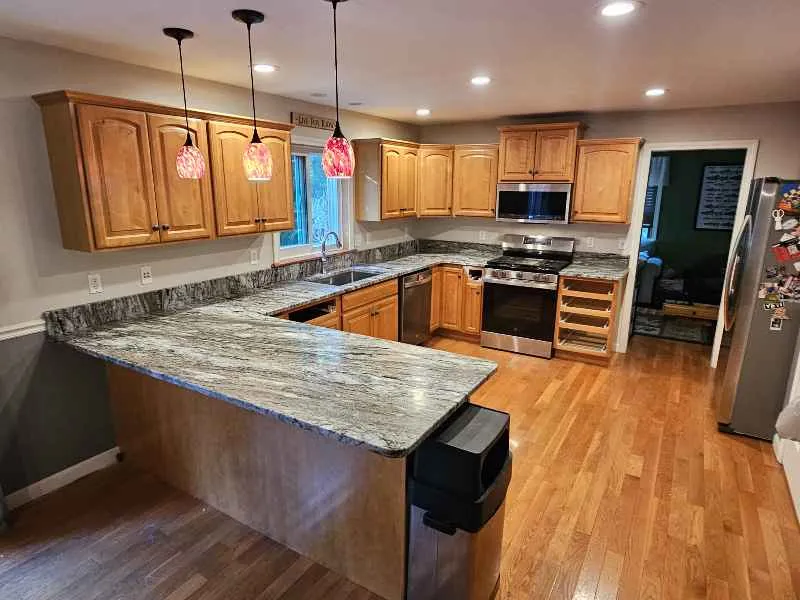
Why Homeowners Mix Countertop Materials
The island and perimeter often do different jobs. The perimeter may hold the sink, range, coffee maker, and most small appliances. The island may be the social center, a serving surface, a homework station, or the visual feature seen from the living room.
Using different materials allows the design to respond to those roles. A controlled quartz perimeter can create a calm work zone while a quartzite or granite island brings natural movement. A dark, quiet island can ground a room with pale perimeter counters. A light island can open up a kitchen surrounded by dark cabinetry.
Mixed surfaces can also make premium material easier to use within a budget. Instead of forcing a statement stone across every run, a homeowner can feature it on the island where its pattern is most visible.
None of those reasons is automatically better than using one material everywhere. Mixing works when there is a clear purpose. If the only reason is that two unrelated samples looked good in separate showrooms, the finished room can feel divided.
Start by Giving Each Countertop a Job
Before comparing color, decide what each surface needs to do. Write down how the perimeter and island will actually be used. That simple step keeps the material choice from becoming only a styling exercise.
For a busy perimeter with a sink and daily food preparation, homeowners may prioritize predictable care, stain resistance, and a quieter pattern around cutouts and seams. On an island used mainly for gathering and serving, the visual impact of a natural slab may carry more weight.
The reverse can work too. A serious cook may want heat-tolerant natural stone near the range and a consistent engineered surface on the island. A family that does almost all prep on the island may want the lowest-maintenance option there.
Material performance varies by specific product and slab, so discuss heat, cleaning, sealing, scratching, and warranty guidance with the fabricator. The design becomes easier once the practical priorities are honest.
The Safest Design Formula: One Leads, One Supports
The most dependable mixed-countertop kitchens establish a visual leader. One surface has the stronger movement, color, or contrast. The other acts as a supporting neutral.
For example, a dramatic quartzite island can pair with a warm white quartz perimeter. A charcoal granite island can sit beside a soft cream surface. A quiet granite perimeter can support an island with broader veining.
Two bold patterns can work, but they require exceptional control over color, scale, backsplash, and flooring. If both stones have high-contrast directional veins, the eye may not know where to rest. Our guide to bold veining or subtle movement can help you decide which surface should lead.
Quiet does not mean cheap or boring. A supporting countertop can have subtle mineral movement, fine crystals, or low-contrast veining. Its job is to connect the room and let the focal surface be appreciated.
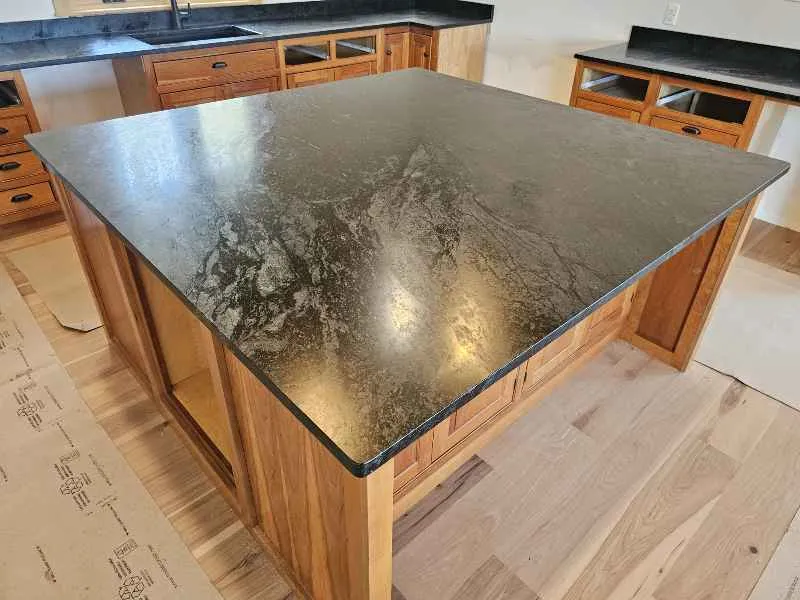
How to Coordinate Color and Undertone
Matching the exact color is not required. In fact, near-matches often look less intentional than clear contrast. What matters is that the two surfaces share a relationship.
Look for a background tone, vein color, or temperature that appears in both. A creamy island stone may contain a taupe line that relates to a greige perimeter. A black island may repeat dark mineral flecks in a pale granite. A warm white quartz may connect to gold movement in quartzite.
Pay attention to warm and cool undertones. A blue-white perimeter beside a yellow-cream island can make both colors look more extreme. A warm gray may bridge them, but only if it is visible in the actual samples.
Place the candidates side by side under the kitchen's lighting. Add the cabinet door, floor, backsplash, wall paint, and hardware. Screens and separate photos cannot show the relationship accurately. If wood is part of the palette, review our guide to countertops with wood cabinets.
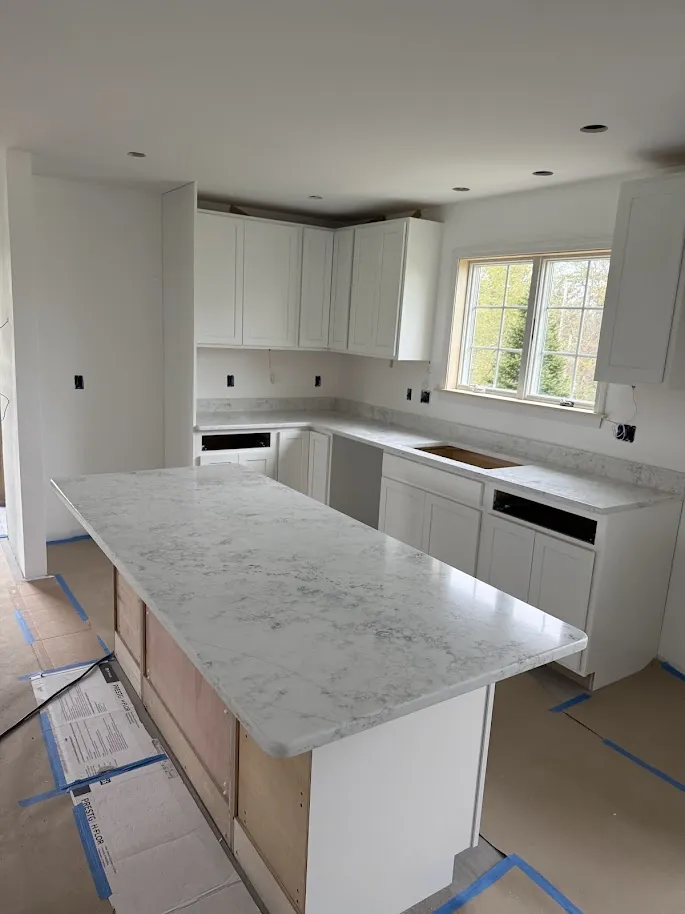
Can You Mix Granite and Quartz?
Yes. Granite countertops and quartz countertops are one of the most practical mixed-material combinations because they offer different visual strengths.
Granite provides natural variation, depth, and one-of-a-kind mineral character. Quartz offers a more controlled pattern and color. A homeowner might use granite on the island as the feature and quartz on the perimeter to keep the rest of the room calm.
The combination can also be reversed. A durable granite may work around the range and sink while a pale quartz island creates a consistent surface for seating and serving.
Do not assume the materials will have identical care rules. Granite may benefit from sealing depending on the stone, while quartz follows the manufacturer's care guidance and should be protected from excessive direct heat. Everyone using the kitchen should understand the difference.
Can You Mix Quartz and Quartzite?
Quartz and quartzite countertops are frequently confused, but they can work beautifully together. Quartz is engineered. Quartzite is natural stone. Their names sound alike; their appearance, variation, and care expectations are not the same.
A restrained quartz perimeter can make a natural quartzite island feel even more special. The quartz can be selected to repeat the quartzite's background rather than trying to copy every vein.
Trying to find an engineered pattern that almost duplicates a natural slab is risky. If the colors or vein scale are slightly off, the mismatch can look accidental. A simpler quartz often creates a cleaner partnership.
View the full quartzite slab and the largest available quartz sample. Natural movement may change across the slab, while an engineered design may repeat across long runs. Both behaviors affect the final layout.
Thickness, Edge, and Finish Still Need to Relate
Mixed materials do not need identical details, but the differences should look intentional. Countertop thickness, edge profile, finish, and overhang all change how the surfaces read in the room.
Using the same simple edge on both materials can create continuity. Another option is a thicker-looking or waterfall treatment on the island and a standard eased edge on the perimeter. That makes the island's different role clear.
A polished island and honed perimeter can work when the contrast is part of the plan. If the finish difference is subtle and unexplained, it may look like one surface was ordered incorrectly.
Material and manufacturer limitations matter. Not every edge or finish is suitable for every slab. Confirm available details before the cabinets, supports, and appliance clearances are finalized.
How the Backsplash Can Unite Two Countertops
The backsplash is often the bridge between mixed countertops. It can repeat a shared neutral, connect vein colors, or stay quiet enough that the two work surfaces carry the design.
A busy patterned tile between two active countertops is one of the easiest ways to overload the room. If the island is bold and the perimeter has noticeable movement, a simple backsplash may be the better choice.
A short stone splash made from the perimeter material can create continuity around the walls. Tile above it can add texture without introducing another stone pattern. A full-height slab backsplash can be beautiful, but it becomes a third large field of pattern and should be planned with restraint.
Choose the countertops before committing to backsplash color. Small shifts in cream, white, gray, or green become obvious when the materials touch.
Will Two Countertops Make a Small Kitchen Feel Busy?
They can, but size alone does not rule out the idea. Contrast, pattern scale, and the amount of visible surface matter more.
In a compact kitchen, use a clear and limited difference. A dark island with a quiet light perimeter is easier to read than two multicolor stones. Keeping the cabinet finish consistent can also make the room feel connected.
Consider the view from the doorway. If both countertops, a patterned floor, open shelving, and a detailed backsplash appear at once, the room may need fewer focal points.
Sometimes one countertop throughout is the strongest choice. It can make short runs feel longer, reduce transitions, and simplify ordering. Mixed materials should improve the room, not merely prove that they can fit.
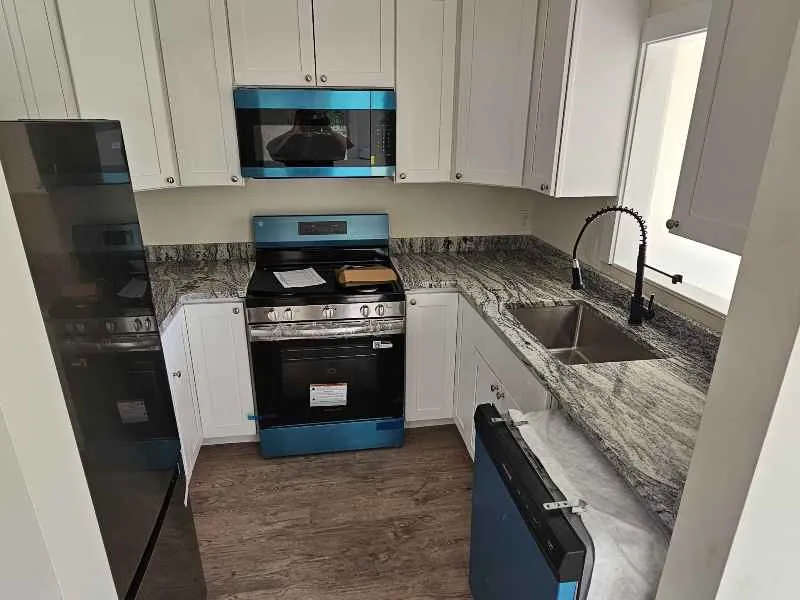
Slab Yield, Seams, and Ordering Can Change the Budget
Mixed countertops do not automatically cost more or less. The answer depends on slab sizes, layout, material tiers, cutouts, seam locations, and how efficiently the pieces fit.
A statement island may require an entire slab even if the square footage is modest, especially when the slab has directional movement or the island needs a large uninterrupted piece. The remaining area may not fit the perimeter runs.
Using two materials can mean two separate slab purchases, two layout plans, and potentially different lead times. On the other hand, it may let the perimeter use a more economical option while concentrating the premium surface on the island.
Ask for an itemized estimate based on the actual plan. Square-foot comparisons alone miss yield, seams, edge work, waterfall panels, sink cutouts, and the labor involved in coordinating two materials.
Common Mixed-Countertop Mistakes
The first mistake is choosing each surface in isolation. The second is trying to make two different products look almost identical. The third is adding a backsplash before the countertop relationship is settled.
Other problems include using two strong directional patterns, ignoring how natural slabs vary, mixing warm and cool whites unintentionally, and assuming every surface can use the same edge or finish.
Homeowners also forget the floor. A combination that looks balanced against a plain showroom wall may compete with a patterned tile or strongly grained wood floor.
Finally, do not let a design trend overrule maintenance. If one surface will frustrate the household every day, it is not the right feature material, no matter how good it looks in a photograph.
Questions to Ask Before You Commit
- What job will each countertop perform?
- Which surface is the focal point, and which one is supporting it?
- What undertone or color connects the two materials?
- How will the cabinets, floor, backsplash, and lighting affect the pairing?
- Do the materials have different cleaning, heat, or sealing requirements?
- Will the project require full slabs of both materials, and what happens to the remaining material?
- Where will seams and major cutouts fall?
- Should the edge, thickness, and finish match or intentionally differ?
Fabricator Recommendation: Approve the Combination as a Room
Do not ask only whether the two countertops match. Ask whether the entire kitchen has a clear hierarchy.
Bring every fixed finish together and view full slabs whenever natural stone is involved. Stand back far enough to see the scale of the patterns. Then look closely at the background colors where the surfaces will meet cabinets and backsplash.
Have the fabricator price the actual layout, not a rough square-foot assumption. Confirm edge details, thickness, seams, overhang support, finish, and care before ordering.
A mixed-countertop kitchen succeeds when the two surfaces feel like different members of the same family, not two separate ideas competing for the room.
Can You Use Two Different Countertops in One Kitchen?
Yes. Two different countertops can make a kitchen more functional, more personal, and more visually balanced.
Use a clear focal point. Repeat an undertone or color. Let one pattern lead. Coordinate the details. Be realistic about maintenance and slab yield.
If the combination needs a long explanation to make sense, keep looking. The right pairing usually feels connected when the materials are placed together.
Plan Your Mixed-Countertop Kitchen With Precision Granite Works
Precision Granite Works helps homeowners throughout Epsom, Concord, Manchester, Southern New Hampshire, the Lakes Region, the Seacoast, and nearby Maine and Vermont compare granite, quartz, quartzite, soapstone, and other stone options for island and perimeter countertops.
Planning a two-countertop kitchen? Bring your cabinet, flooring, and backsplash samples to our showroom at 1022 Dover Road in Epsom so you can compare full slabs and build a combination that works as one room. Explore our kitchen island countertops or request a quote when you are ready to discuss your layout.
Frequently Asked Questions
Can you use two different countertops in one kitchen?+
Should the island countertop be different from the perimeter?+
Can you mix granite and quartz in the same kitchen?+
How do you match two countertop colors?+
Should mixed countertops have the same thickness and edge?+
Can the island be more dramatic than the perimeter?+
Do two countertop materials make a small kitchen look busy?+
Is it harder to maintain two different countertop materials?+
Ready to Start Your Project?
Contact Precision Granite Works for a free consultation and quote at our Epsom, NH showroom.
About the Author
Written by the team at Precision Granite Works — New Hampshire's family-owned countertop fabricators. Jillian and Shawn Woodward and their team serve homeowners and builders across all of NH from our Epsom showroom.